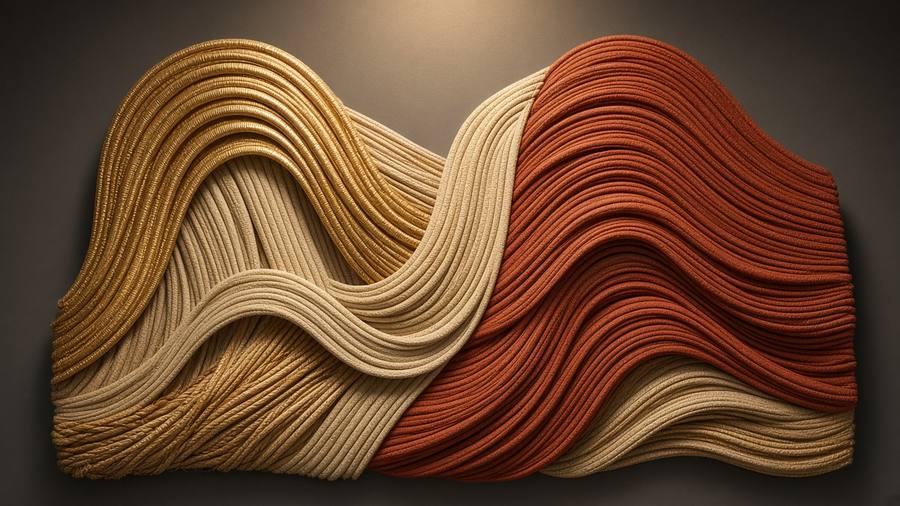
ST. LOUIS — Colombian fiber artist Olga de Amaral has spent more than six decades treating the loom as a starting point rather than a limit. Olga de Amaral: Weaving the Infinite, now on view at the Pulitzer Arts Foundation from 10 September 2026 through 31 January 2027, is the most wide-ranging survey yet of how her practice moves between art, craft and design — and how architectural scale became her signature.
The exhibition is co-organised with Cooper Hewitt, Smithsonian Design Museum, where it travels from 2 April to 11 October 2027. At the Pulitzer, 86 works — monumental fiber pieces, furnishings and clothing from the commercial studio Telas Amaral, plus textiles and ceramics from Amaral’s personal collection — are presented as one continuous experiment rather than separate careers.
From Cranbrook to woven walls
Born Olga Ceballos Vélez in Bogotá in 1932, Amaral trained in architectural drafting at the Colegio Mayor de Cundinamarca and studied textiles at Cranbrook Academy of Art in Michigan in 1954. After returning to Colombia she co-founded Telas Amaral with her husband, Jim Amaral, in 1957. By the 1960s she was teaching at Haystack Mountain School of Crafts and appearing in MoMA’s Wall Hangings; a solo Woven Walls show followed at New York’s Museum of Arts and Design in 1970. She represented Colombia at the Venice Biennale in 1986 and still lives in Bogotá.
The Pulitzer installation traces that arc from early Cranbrook-era textiles to off-loom constructions of the 1970s onwards. A focal point is the Muros tejidos (Woven Walls) series, which pulls Amaral’s drafting background into three-dimensional fiber. Heavy wool, horsehair and modular woven units let the work answer light and architecture instead of hanging flat. Two panels from her most ambitious commission, El gran muro (The Great Wall), 1976 — made for the atrium of Atlanta’s Peachtree Plaza Hotel for architects John Portman & Associates — appear in the galleries; St. Louis Magazine notes the full multi-panel weaving once stretched about 93 feet tall.
Later works introduce acrylic paint, gold leaf, Japanese paper and gesso, pushing fiber toward painting, drawing and sculpture at once. Curatorial assistant Molly Moog told St. Louis Magazine that off-loom handwork freed Amaral from loom-bound scale: when you work with your hands, she said, “anything is possible.” Influences range from Andean weaving and Wayuu garment forms to Scandinavian techniques learned at Cranbrook and the luminosity of Japanese kintsugi.
Design studio as laboratory
What distinguishes this survey is Telas Amaral’s first deep inclusion alongside the museum pieces. Area rugs, thick carpets in leather, horsehair, wool and cotton, upholstery mixing natural and metallic threads, a woman’s dress suit and a Wayuu-inspired tunic sit next to the fine-art weavings. Senior curator Stephanie Weissberg, co-curating with Cooper Hewitt’s Christina L. De León, argues the studio was where Amaral refined modular, repeatable units that generated “seemingly endless formal possibilities.”
Pulitzer executive director Cara Starke framed the show as filling a scholarship gap for an artist whose critical recognition has only recently broadened. A fully illustrated catalogue from Princeton University Press is planned for spring 2027, with essays by the curators, design historian Antonio Sánchez, and conservators Emilia Cortes and Kira Eng-Wilmot.
Admission to the Pulitzer remains free; the museum is open Thursday–Sunday, with Friday evenings until 8pm. For visitors, Weaving the Infinite is less a tidy retrospective than a map of how one Colombian studio practice kept rewriting what a textile can be — before the work heads to New York’s Museum Mile next spring.
This article draws on the Pulitzer’s August 2026 press release, the museum’s exhibition page, and St. Louis Magazine’s September preview. Quoted remarks follow those outlets.