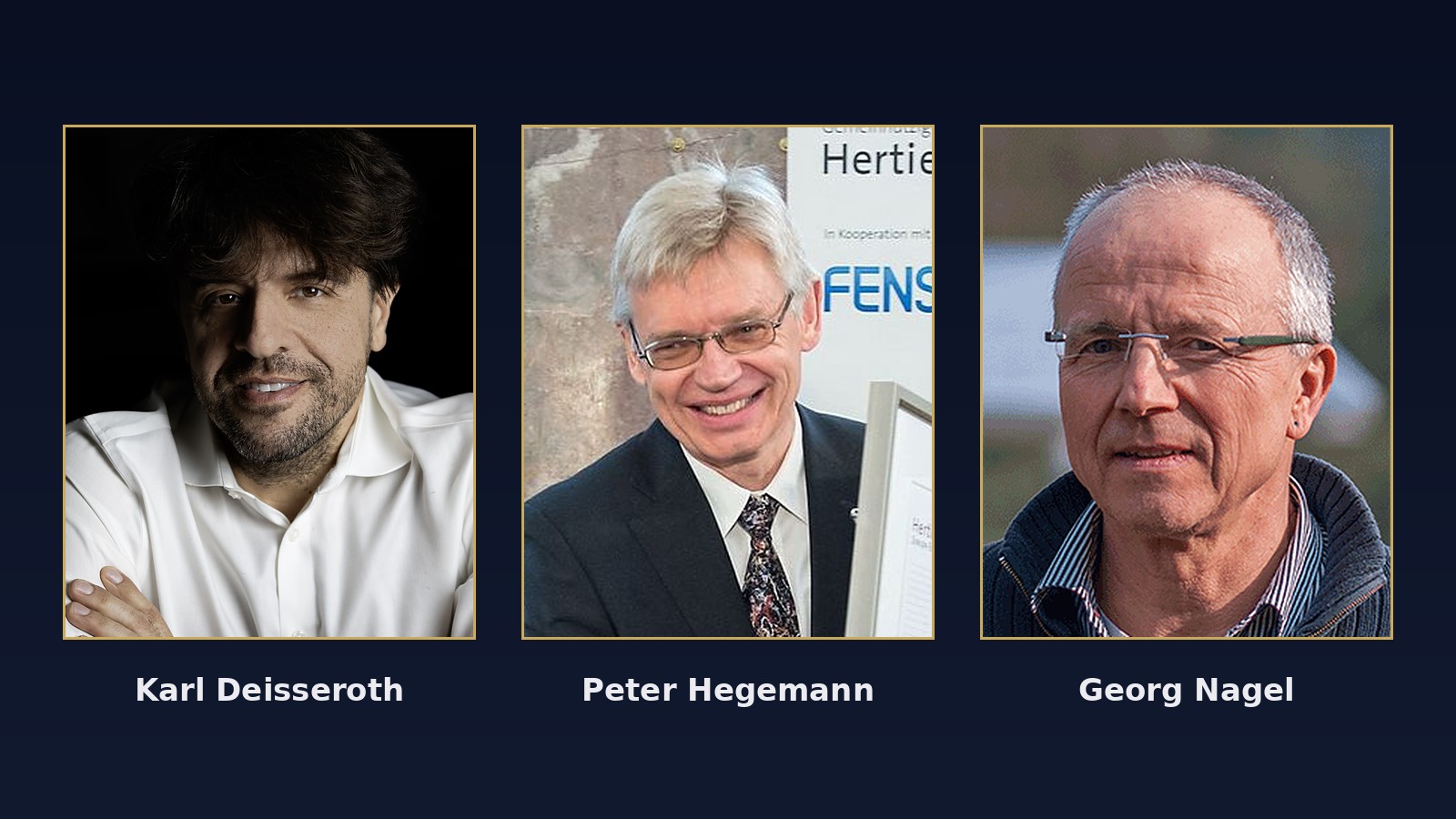
The Nobel Prize in Medicine 2026 has gone to the scientists who taught the brain to respond to light. On Monday 5 October, the Nobel Assembly at Karolinska Institutet in Stockholm awarded the 2026 Nobel Prize in Physiology or Medicine jointly to American neuroscientist and psychiatrist Karl Deisseroth and German researchers Peter Hegemann and Georg Nagel "for their discoveries concerning light-gated ion channels and optogenetics". The announcement, made at 3:00 PM India time, opened Nobel week and rewards a technique that now runs through neuroscience labs across the world. Here is who won, what they discovered, why it matters for medicine, and what comes next.
Who won the Nobel Prize in Medicine 2026?
The three laureates share the prize equally. According to the Nobel Assembly's press release:
Karl Deisseroth, born in 1971 in Boston, is D.H. Chen Professor of Bioengineering and of Psychiatry and Behavioral Sciences at Stanford University and the Howard Hughes Medical Institute in the United States. He earned his PhD and MD at Stanford.
Peter Hegemann, born in 1954, is Hertie Senior Professor of Neuroscience at Humboldt University of Berlin. His prize-winning work was done at the Max Planck Institute for Biochemistry in Martinsried, Germany.
Georg Nagel, born in 1953, is Professor of Molecular Plant Physiology at the University of Würzburg. His prize-winning discoveries were made at the Max Planck Institute for Biophysics in Frankfurt.
Reuters and the Associated Press reported their ages as 54, 71 and 73 respectively. Thomas Perlmann, Secretary-General of the Nobel Assembly, said he reached all three by phone on Monday and that they were "surprised and delighted". "All three said the same thing — that they thought it was absolutely wonderful to receive the prize together, calling each other friends," he told reporters.
What is optogenetics? The discovery explained
Optogenetics is a method for switching individual nerve cells on or off in a living brain using light. It lets researchers prove which circuits actually cause a memory, a feeling or a behaviour, rather than simply noting which brain regions light up at the same time. Per Svenningsson, chair of the Nobel Committee for Physiology or Medicine, said the method "provides opportunities for mapping the brain in a way that we could once only dream of."
The story begins not with a brain but with pond algae. Hegemann wanted to know how Chlamydomonas, a single-celled green alga, swims towards light so quickly. Reuters reports that in the early 1990s he proposed that a single protein might both capture light and act as an ion channel. Nagel tested the idea by injecting the alga's genes into frog eggs, and together, in the early 2000s, they identified channelrhodopsin: a protein that opens a channel when hit by blue light, letting charged ions rush into the cell and create an electrical impulse. Crucially, the effect worked in whatever cell they put it into. In 2003 they showed it could make human and hamster cells respond to light.
Deisseroth then turned that algal protein into a switch for neurons. He introduced the channelrhodopsin gene into rat nerve cells and, by shining blue light on them, triggered nerve signals, publishing the breakthrough in 2005. The technique was named optogenetics in 2006, and by 2007 he had made the light switch work in the brains of living mice. In later experiments, Reuters notes, he used light to move mouse whiskers by activating specific cells in the motor cortex and to wake sleeping mice, confirming that particular neurons control wakefulness.
Why this Nobel matters for brain disorders
For most of the 20th century, the committee says, our picture of the brain was "like a sketch map, full of question marks". Optogenetics gave researchers a way to test cause and effect directly. Scientists now use it in animal models of schizophrenia, Alzheimer's disease, Parkinson's disease, epilepsy and addiction, conditions that affect millions of people and have limited treatment options. "By understanding which cells are active in these diseases in mice, we can understand where to look in humans," Karolinska professor Anna Wedell told Reuters. The committee also notes the method is revealing how the nervous system interacts with organs such as the heart and gut.
Can optogenetics restore sight?
The first steps into clinical medicine are already under way. In trials for retinitis pigmentosa, an inherited disease that destroys the eye's light-sensing rods and cones, researchers insert a light-sensitive protein into the surviving retinal cells. According to the BBC, patients regained some vision when wearing special goggles that emit light to activate the protein. "Optogenetics has been used to partially restore vision in blind patients with retinitis pigmentosa," Svenningsson said. Reuters reports that the most advanced treatments in development include a vision-restoration therapy from US company Nanoscope and an autism spectrum disorder therapy from US biotech MapLight, though both are still some time away from reaching patients. Researchers also hope the approach could one day make cochlear implants more precise.
Nobel Prize 2026 prize money
The 2026 prize is worth 12 million Swedish kronor, about $1.2 million or roughly £900,000, split equally between the three laureates. Each also receives a gold medal and diploma at the award ceremony in Stockholm on 10 December, the anniversary of Alfred Nobel's death. The win follows earlier honours: Hegemann and Nagel shared the 2020 Shaw Prize in Life Science and Medicine, and Deisseroth received the Japan Prize in 2023.
Who won last year, and what is next in Nobel week
The 2025 medicine prize went to Mary E. Brunkow, Fred Ramsdell and Shimon Sakaguchi for discoveries about how the immune system is kept in check. This year's medicine award kicks off a packed week of announcements. In India time, the Nobel Prize in Physics follows on Tuesday 6 October at 3:15 PM IST, Chemistry on Wednesday 7 October at 3:15 PM, Literature on Thursday 8 October at 4:30 PM, and the Nobel Peace Prize from Oslo on Friday 9 October at 2:30 PM. The Sveriges Riksbank Prize in Economic Sciences closes the season on Monday 12 October at 3:15 PM IST. All announcements are streamed live on NobelPrize.org.
For now, the 2026 Nobel Prize in Medicine belongs to a strikingly unlikely chain of curiosity: an alga steering towards the sun, a gene tested in frog eggs, and a psychiatrist who wanted to know why depression steals joy. Together, they gave science a light switch for the mind.
Sources: Nobel Assembly at Karolinska Institutet press release (NobelPrize.org, 5 Oct 2026); Karolinska Institutet news; Reuters (5 Oct 2026); BBC News (5 Oct 2026); Associated Press via NPR (5 Oct 2026).
Cover photos (left to right): Karl Deisseroth / Wikimedia Commons, CC BY-SA 4.0 (Christopher Michel); Peter Hegemann / Wikimedia Commons, CC BY-SA 4.0 (Millencolin); Georg Nagel / Wikimedia Commons, CC0 (Millencolin). Cropped and combined.