For most of the 20th century, neuroscientists studying the living brain had a problem. They could see which regions lit up and which were damaged, but they struggled to prove what caused what. The map was, in the words of the Nobel Assembly at Karolinska Institutet, "like a sketch map, full of question marks and unknowns".
On 5 October 2026 the Assembly awarded the Nobel Prize in Physiology or Medicine to three scientists who handed researchers a way to fill in that map. Karl Deisseroth of the Howard Hughes Medical Institute and Stanford University, Peter Hegemann of Humboldt University of Berlin and Georg Nagel of the University of Würzburg share the prize "for their discoveries concerning light-gated ion channels and optogenetics".
The prize money, 12 million Swedish kronor, will be split equally between them.
A curious question about a tiny alga
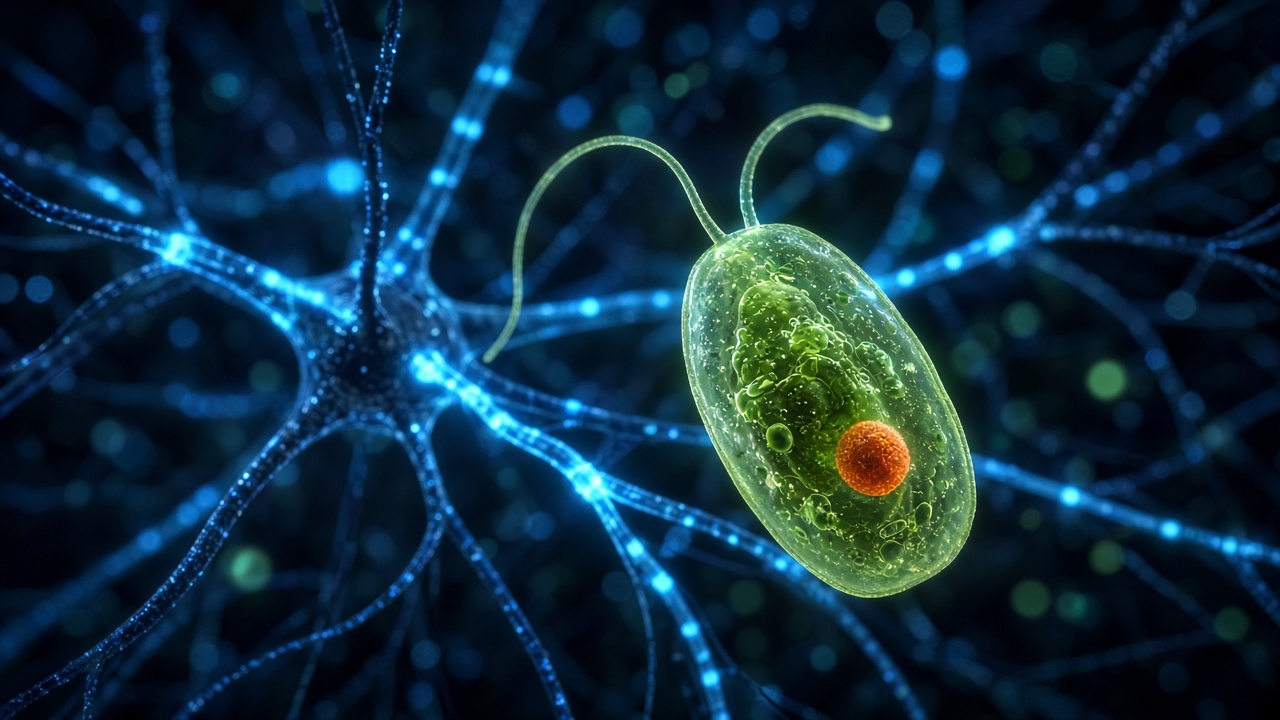
The story does not start in a brain. It starts with a single-celled green alga called Chlamydomonas, and a question Hegemann could not let go of: how does this organism know which way to swim towards the light?
Chlamydomonas has an eyespot, a small light-sensing patch. In the early 2000s Hegemann and Nagel identified a protein on the cell's surface that behaves unusually. They named it channelrhodopsin. When blue light hits it, a channel opens through the protein, charged ions rush into the cell, and an electrical impulse follows.
That alone would have been a neat piece of plant biology. What made it extraordinary, according to the Nobel Assembly, was a second finding: whatever cell the researchers put the protein into, that cell became sensitive to light. The work drew on experiments in frog eggs, one of biology's standard test tubes for studying how foreign proteins behave.
Both German laureates did their prize-winning work at Max Planck institutes — Hegemann at the Max Planck Institute for Biochemistry in Martinsried, Nagel at the Max Planck Institute for Biophysics in Frankfurt.
From pond to neuron
Nerve cells communicate through electrical signals. A protein that converts light into an electrical impulse is, in effect, a remote control for a neuron — if you can get it inside one.
That is what Deisseroth, a psychiatrist and bioengineer, set out to do. He introduced the gene for channelrhodopsin into nerve cells taken from rats. Shining blue light on them triggered a nerve signal. He published that result in 2005.
Two years later, in 2007, he made the same light-controlled switch work in the brains of living mice. That step turned a laboratory curiosity into a method that could connect individual circuits of cells with real behaviour in a living animal.
The technique became known as optogenetics: genetics to put the light-sensitive protein into chosen cells, optics to switch them on with precision.
Why it changed neuroscience
The key word is causation. Earlier tools could record that a group of neurons was active when an animal felt fear or formed a memory. Optogenetics lets scientists flip those neurons on, with millisecond timing, and watch what happens.
According to the Nobel Assembly, researchers have since used the method to reveal neural circuits governing specific memories, feelings and behaviours — including ones relevant to neurological and psychiatric disorders. The technique spread quickly through laboratories worldwide after 2005 and is now a standard part of the modern neuroscience toolkit.
"Optogenetics provides opportunities for mapping the brain in a way that we could once only dream of," said Per Svenningsson, Chair of the Nobel Committee for Physiology or Medicine, in the prize announcement.
From the lab to the clinic
Optogenetics is mostly a research tool rather than a treatment. But the Nobel Assembly points to one clinical frontier: researchers are using the method in attempts to restore sight in people with visual impairment. The idea is simple to describe and hard to do — make surviving cells in a damaged retina respond to light themselves.
It is an apt return to where the story began. A protein that evolved to help an alga find the sun is now being tested as a way to help people see.
Who the laureates are
Karl Deisseroth, born in 1971, earned his PhD (1998) and MD (2000) at Stanford, where he is D.H. Chen Professor and Professor of Bioengineering and of Psychiatry and Behavioral Sciences.
Peter Hegemann, born in 1954, received his PhD in 1984 at the Max Planck Institute for Biochemistry. He is Hertie Senior Professor of Neuroscience at Humboldt University of Berlin.
Georg Nagel, born in 1953, received his PhD in 1988 at the University of Frankfurt. He is Professor of Molecular Plant Physiology at the University of Würzburg.
The mix matters. Two plant and membrane biologists chasing a question about algae, and a clinician-engineer looking for a way into the brain. None of the three could have produced optogenetics alone.
The bigger lesson
Nobel committees like a good origin story, and this one is hard to beat. Nobody set out to build a brain switch by studying pond life. Hegemann, the Assembly notes, was driven by curiosity about how an alga swims towards light.
That is the quiet argument embedded in this year's prize: basic research on obscure organisms can end up reshaping an entire field. Optogenetics "has fundamentally altered our understanding of the brain", the Assembly said, adding that every day brings new discoveries towards one of humanity's oldest puzzles — how the brain actually works.
The laureates will receive their medals and diplomas at the Nobel ceremonies in Stockholm in December.
Quick facts
Prize: Nobel Prize in Physiology or Medicine 2026
Announced: 5 October 2026, by the Nobel Assembly at Karolinska Institutet
Laureates: Karl Deisseroth (USA), Peter Hegemann and Georg Nagel (Germany)
Citation: "for their discoveries concerning light-gated ion channels and optogenetics"
Key protein: channelrhodopsin, from the alga Chlamydomonas
Milestones: 2005 light-triggered nerve signals in rat neurons; 2007 control in living mice
Prize money: SEK 12 million, shared equally