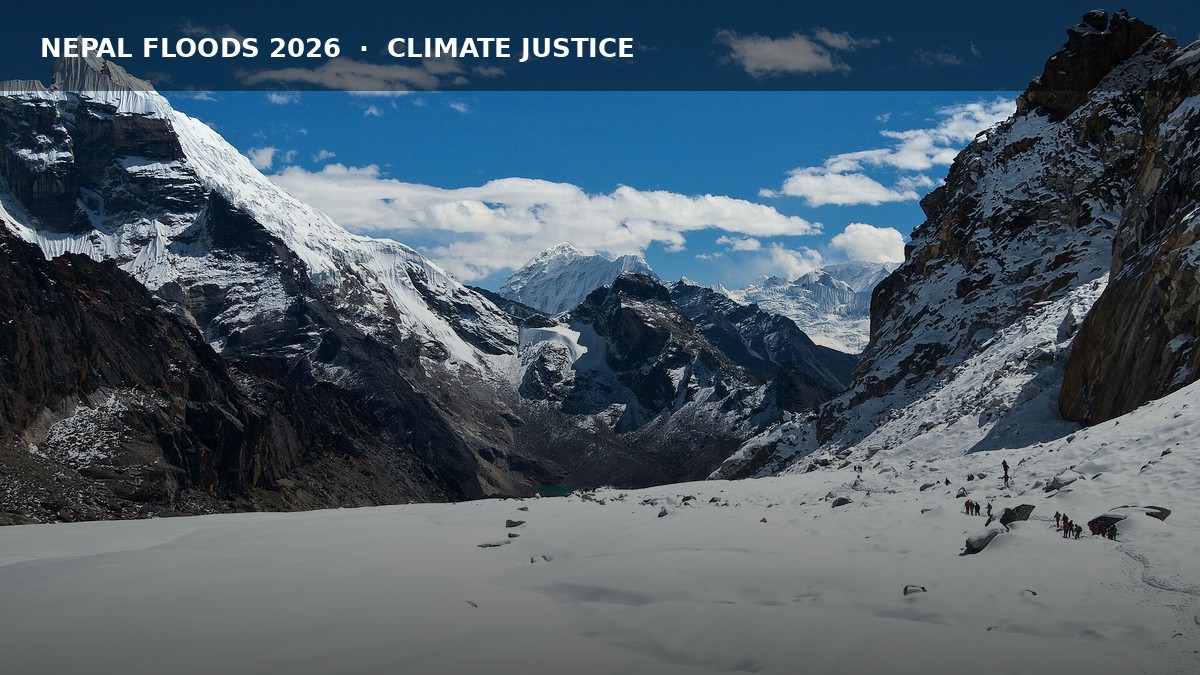
Nepal floods 2026 moved from rescue headlines into a longer climate justice argument after a late-August Himalayan glacier collapse sent catastrophic water and debris through valleys in Nepal and China’s Tibet region. By early September, Reuters reported at least 1,300 people confirmed dead and more than 5,300 missing across the two sides of the border, with hydropower plants, trade routes, roads, bridges, and settlements destroyed. Nepal’s disaster officials then framed an initial about $5 billion five-month recovery need as a shared global responsibility—not only a domestic rebuild bill. This TRENDS Ideas explainer synthesises Reuters exclusives and science follow-ups for readers still searching the disaster cluster.
What happened
On 26 August 2026, a glacier collapse in the Himalaya triggered flash floods and mudflows downhill. Nepal bore the brunt of infrastructure loss—Reuters cited more than a dozen hydropower plants among swept assets—while search operations continued into September in remote districts. Later wire updates revised death and missing counts upward as bodies were recovered and registries reconciled; treat any single number as a snapshot, not a final census.
The $5 billion climate-justice pitch
In a 9 September 2026 Reuters exclusive, disaster management chief Dharam Raj Uprety said Nepal would share an initial recovery estimate covering roughly the next five months with the World Bank, Asian Development Bank, and embassies including the United States, Britain, India, China, Japan, and the European Union. Geologist Prakash Pokhrel of the National Disaster Risk Reduction and Management Authority argued countries that contribute most to emissions should recognise shared accountability when low-emitting Nepal absorbs outsized loss. China said it would assist within its capacity while managing its own border-side relief.
Why scientists link climate change
A 17 September 2026 Reuters science desk piece reported researchers concluding climate change likely helped precondition the glacier collapse—through thinning ice, permafrost thaw, meltwater loading, and unusual warmth—even where the precise trigger chain remains under study. That finding strengthens Kathmandu’s public framing without converting every landslide into a simple slogan; attribution science and humanitarian logistics still move on different clocks.
The Pakistan funding caution
Nepal’s outreach explicitly studies the lag after Pakistan’s 2022 floods: Reuters noted roughly $11 billion in pledges, with a large oil-import share and only about $3.4 billion disbursed by early 2024 on government estimates. The lesson Kathmandu is signalling to donors: announce less theatre, move more cash into shelters, schools, and rebuilt infrastructure.
People also ask: is the danger over after September rains?
No. Late-September reporting described renewed monsoon rainfall triggering fresh floods and landslides in parts of Nepal, with warnings still active in vulnerable districts. Recovery messaging and hazard alerts can overlap for weeks; check Nepal’s NDRRMA and trusted wires for current advisories rather than assuming a single “all clear.”
Why this ranks now
India and global search interest clusters around “Nepal floods,” “Nepal glacier collapse,” and climate-justice / aid queries weeks after the peak death-toll spike—when explainers that connect science, dollars, and donor behaviour outlast match-day stubs. Mapping the story to Ideas (not sports) keeps the piece durable inside our culture-and-arguments lane.
Related Sunday Profile reading
For adjacent Ideas / Technology accountability lanes on this desk, see our live AI Slowdown Debate Labs 2026 (https://www.thesundayprofile.com/ai-slowdown-debate-labs-2026) and AMD Buys World Labs: Fei-Fei Li $8.2B Deal (https://www.thesundayprofile.com/amd-world-labs-fei-fei-li)—different topics, same habit of sourcing hard claims before the next search wave.
Sources and caveats
$5B pitch, 1,300+ / 5,300+ early September toll framing, Uprety/Pokhrel quotes, donor list, China response, Pakistan pledge lag: Reuters exclusive (9 Sep 2026). Climate preconditioning of glacier collapse: Reuters (17 Sep 2026) and Al Jazeera science summary. Later death/missing revisions and late-September rain: Reuters/News18/The Hindu follow-ups. Tolls and pledges continue to move—recheck primary wires before republishing figures.