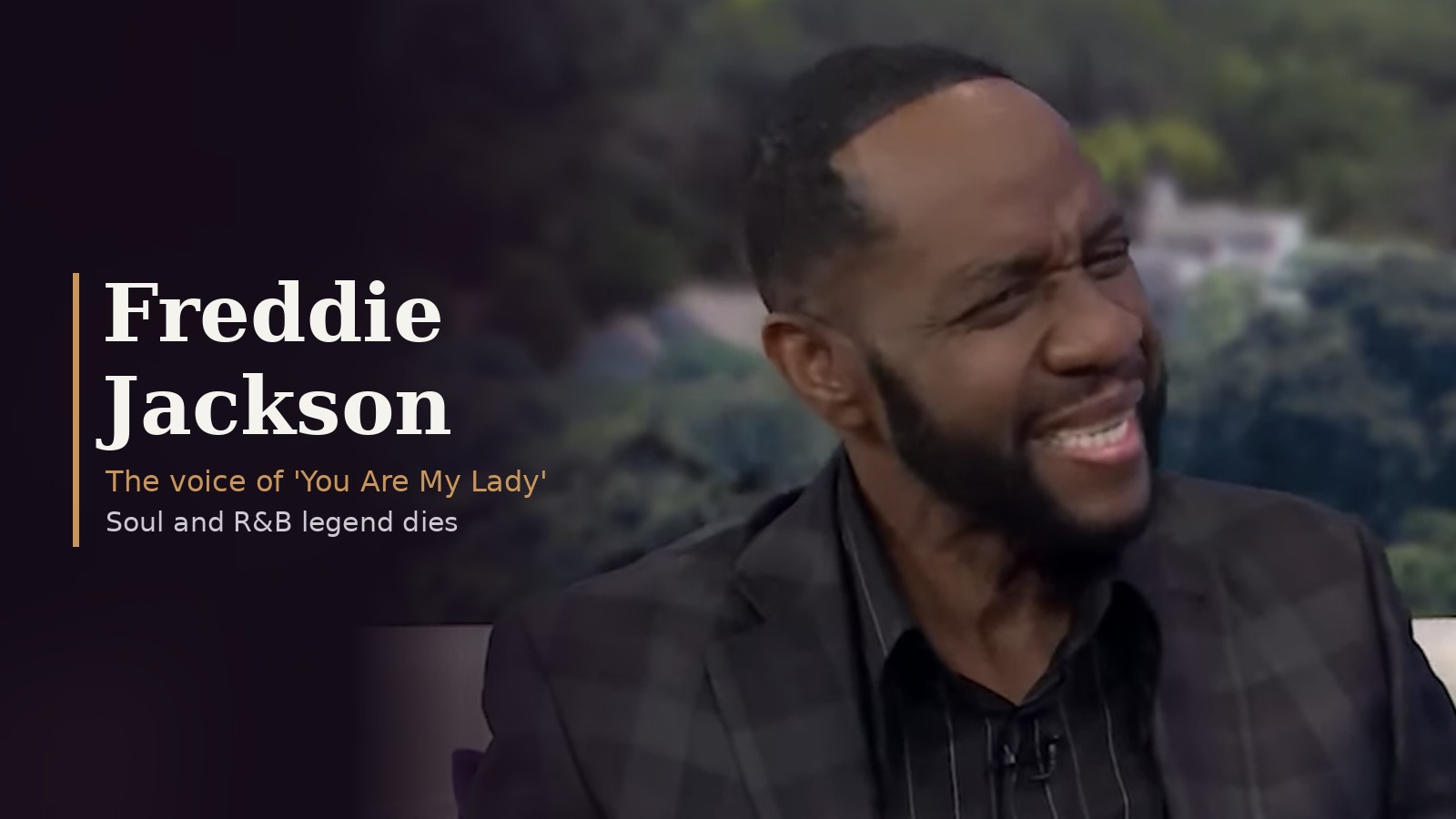
Freddie Jackson, the Harlem-born R&B singer whose silky ballads "Rock Me Tonight (For Old Times Sake)" and "You Are My Lady" defined the quiet storm sound of the 1980s, has died. His family announced on his official social media accounts on Tuesday, 6 October 2026, that he had died the previous night, Monday 5 October. Outlets including Hindustan Times and Rolling Out reported his age as 69. No cause of death has been announced, and the family said details of arrangements would follow in the coming days.
Freddie Jackson death: what the family said
"It is with profound sadness and heavy hearts that we share the passing of our beloved Freddie Jackson, who went home to rest last night," the statement on the singer's Instagram page read, as reported by Hindustan Times and Rolling Out.
"Freddie was more than a legendary voice. He was a kind, generous soul who loved his fans, his family, his friends, and his music with everything he had," the family wrote. "For decades he gave us the songs that became the soundtrack to our love stories, our celebrations, and our most treasured memories. That gift will live on forever."
The message also thanked fans directly: "To everyone who ever sang along, danced, or felt something when Freddie took the stage: thank you. You were family to him, and he carried your love with him always." It asked people to keep his family and friends in their prayers and closed with: "Rest in peace, Freddie. Your legacy and your voice will live on forever."
Freddie Jackson cause of death: what we know
As of Tuesday evening, the family had not given a cause of death, and The Sunday Profile has not seen any official statement on one. In September 2024, Jackson told People magazine that he had been diagnosed with kidney disease and said he was facing it with "openness and resilience". There is no confirmation that the illness was connected to his death, and claims circulating online that name a specific cause should be treated with caution until his family or representatives say more.
From Harlem church choir to Mystic Merlin
Frederick Anthony Jackson grew up in Harlem, New York, and trained as a gospel singer at the White Rock Baptist Church. It was there that he met Paul Laurence, who would become his producer and long-time songwriting partner. After school he sang with Laurence's group on the New York club circuit, then moved to the West Coast in the late 1970s to front the California funk band Mystic Merlin, which released three studio albums between 1980 and 1982.
Back in New York, he worked with Laurence at Hush Productions, recording demos and singing backing vocals for Melba Moore, who had spotted his nightclub act in 1981. In 1984 he signed with Capitol Records.
'Rock Me Tonight' and 'You Are My Lady': the hits
Jackson's debut album, Rock Me Tonight, arrived in 1985 and made him a star almost overnight. The Laurence-written title track spent six weeks at No. 1 on the Billboard R&B chart. Its follow-up, "You Are My Lady", written and produced by Barry J. Eastmond, also went to No. 1 on the R&B chart, peaking the week of 5 October 1985, exactly 41 years before his death. It became his biggest crossover hit, reaching No. 12 on the Billboard Hot 100 and No. 3 on the adult contemporary chart. The album topped the R&B albums chart and went platinum.
The run continued with 1986's Just Like the First Time, another platinum record that produced three more R&B No. 1s in "Tasty Love", "Have You Ever Loved Somebody" and "Jam Tonight", plus a chart-topping duet with Melba Moore, "A Little Bit More". Later albums kept the streak going, with "Hey Lover", "Nice 'N' Slow", "Do Me Again" and "Love Me Down" all reaching No. 1 on the R&B chart.
He was nominated for Grammy Awards for Best New Artist and for Best R&B Vocal Performance, Male, for "You Are My Lady", and he won an American Music Award for Favourite Soul/R&B Single for "Nice 'N' Slow".
Beyond the charts: film, TV and a long second act
Jackson's voice reached audiences beyond R&B radio. He sang "Love Survives" with Irene Cara for the soundtrack of the 1989 animated film All Dogs Go to Heaven, appeared as a lounge singer in a 1989 episode of The Golden Girls, and had a role in Abel Ferrara's film King of New York.
As R&B moved towards new jack swing and hip-hop soul in the 1990s, his chart success slowed. He left Capitol for RCA in 1993 and later recorded for independent labels, releasing albums including It's Your Move (2004), Transitions (2006), For You (2010) and Love Signals (2018). He kept touring for decades, sharing stages with fellow veterans such as Jeffrey Osborne, Peabo Bryson, Melba Moore and Stephanie Mills, and in 2019 he headlined Detroit's African World Festival.
Why Freddie Jackson mattered to R&B
Jackson was one of the defining voices of quiet storm, the late-night, romance-first strand of R&B that ruled Black radio in the mid-1980s alongside artists such as Luther Vandross and Anita Baker. His records were built on patient tempos, lush arrangements and a warm, controlled tenor, and they became fixtures at weddings, anniversaries and slow dances for a generation of listeners. Few singers of the era matched his string of R&B chart-toppers in such a short span.
News of his death made "Freddie Jackson" one of the top trending searches in the United States and the United Kingdom on Tuesday, according to Google Trends, as fans returned to the songs that made his name. The Sunday Profile will update this story when the family shares details of a memorial or when a cause of death is confirmed.
Sources: family statement on Freddie Jackson's official Instagram account, as reported by Hindustan Times, Rolling Out and Leadership (6 October 2026); People (September 2024); Billboard chart records as compiled on Wikipedia; Google Trends (US and UK, 6 October 2026).
Cover photo: Freddie Jackson in 2019 / Sister Circle TV via Wikimedia Commons, CC BY 3.0