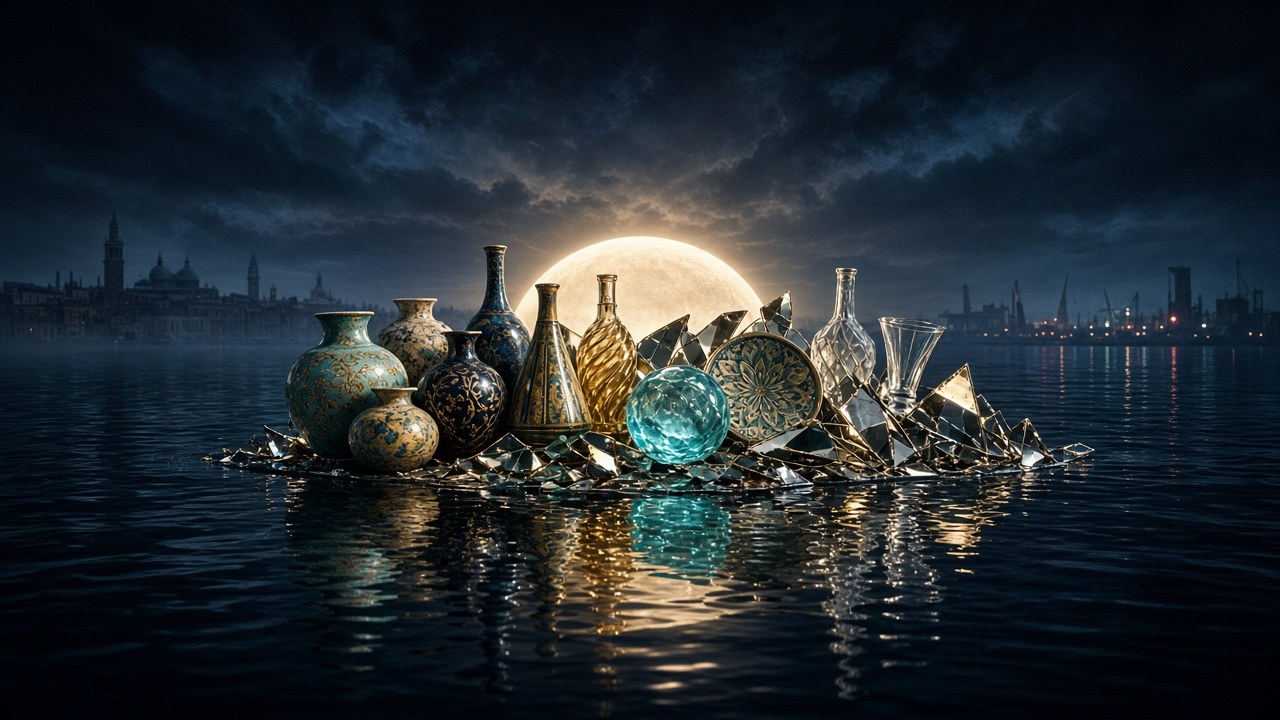
VENICE — While AI executives dominate headlines, the fourth Homo Faber Biennial on San Giorgio Maggiore is making a quieter, physical argument: that craft still needs hands, time and light you can walk through. British artist and stage designer Es Devlin directs *An Island of Light*, open 1–30 September 2026 at Fondazione Giorgio Cini, wrapping more than 700 handmade objects by roughly 500 artisans from more than 70 countries into 15 immersive installations.
The Michelangelo Foundation, with Fondazione Cologni dei Mestieri d’Arte and Fondazione Giorgio Cini, presents the biennial as a celebration rather than a trade fair. Official materials describe Devlin’s narrative as inspired by the Venetian lagoon’s archipelago — each maker an island of skill inside wider waters of craftsmanship — shaped with water, mirrors, movement and carefully staged illumination.
Craft as counterweight, not museum nostalgia
Alberto Cavalli, executive director of the Michelangelo Foundation, told Designboom the event is meant to put handmade objects back at the centre of how architects and interior designers specify materials and techniques. “We may live in the era of AI, but we’re still made of flesh and bones, and our senses are still the best interceptor of the spirit of the time,” he said. Technology, in his framing, is a tool with a correct and incorrect use: useful when it extends the “intelligent hand,” harmful when it turns makers into tools themselves.
Devlin has pushed a related idea in interviews around the opening: that “artisan thought” happens through the fingertips, and that visitors should think with the body as well as the cortex. Bloomberg’s coverage of the edition frames the same thesis for a design-insider audience already streaming to Venice this September — craft as a live case against dematerialisation, not a heritage display.
Fifteen rooms, one lagoon logic
Installations range from working ateliers to kinetic spectacle. *A Language of Hands* rebuilds an artisan workshop for live demonstrations. *A Full Moon Rising*, installed in the Fondazione’s former 1960s swimming pool, places Korean moon jars and other handmade vessels on a semicircular structure that slowly emerges from the water — an illusion The Hindu’s on-site report calls the show’s standout, and that foundation staff described as the first stop they would make “coming in from outer space.”
Elsewhere, *An Alphabet of Objects* seats more than 200 pieces on a kinetic structure whose backlighting throws silhouettes onto the walls. *A Great Turning* rotates a two-axis kinetic mirror mosaic over shallow water in the Palladian Cloister, reflecting architecture and sky. *A Feast of Light* turns the Palladian refectory into a near-monochrome banquet of porcelain, glass, paper, textile, marble and mother-of-pearl under a vertical shaft of light. *An Infinite Birdsong* multiplies handmade birds and insects inside a mirrored enclosure.
Young Ambassadors — about 90 design and applied-arts students selected by Homo Faber — guide visitors through techniques and stories. Parallel programmes include live artisan demos, Mazda-presented workshops in hanko carving and kintsugi, culinary routes, and Homo Faber in Città itineraries that open Venetian workshops listed on the foundation’s digital guide.
Why the edition matters now
Homo Faber has run since 2018 as a biennial of exceptional craftsmanship. The 2024 edition, directed by Luca Guadagnino as a *Journey of Life*, set a high bar for narrative staging. Devlin’s 2026 chapter inherits that format but aims the metaphor squarely at light — visibility for makers as well as optics in the rooms. The Hindu notes more than 40 Indian artists and ateliers among the cohort, supported in part through the JSW Foundation, including names such as Ankon Mitra and Shalini Mithal, Gunjan Gupta, Rooshad Shroff, Vikram Goyal and Tarun Tahiliani.
For readers outside Venice, the news is less a travel tip than a design-world signal: a stage designer known for concerts by Lady Gaga, Beyoncé, Bad Bunny and U2 is spending her institutional capital on slow making at the exact moment generative tools claim to invent form. Cavalli’s line about tools — hammers versus scissors — is the operational takeaway. Homo Faber does not ban digital fabrication; it insists human judgment remain the author.
Tickets and programme details remain on homofaber.com through 30 September 2026. What to watch next is whether the Young Ambassadors and Fellowship pipelines convert visitor emotion into sustained commissions — and whether design practices leave the island specifying craft the way they now specify mass-produced finishes.
This article draws on the official Homo Faber 2026 programme, Designboom’s interview with Alberto Cavalli, and The Hindu’s on-site report published 19 September 2026. Quotes follow those outlets.