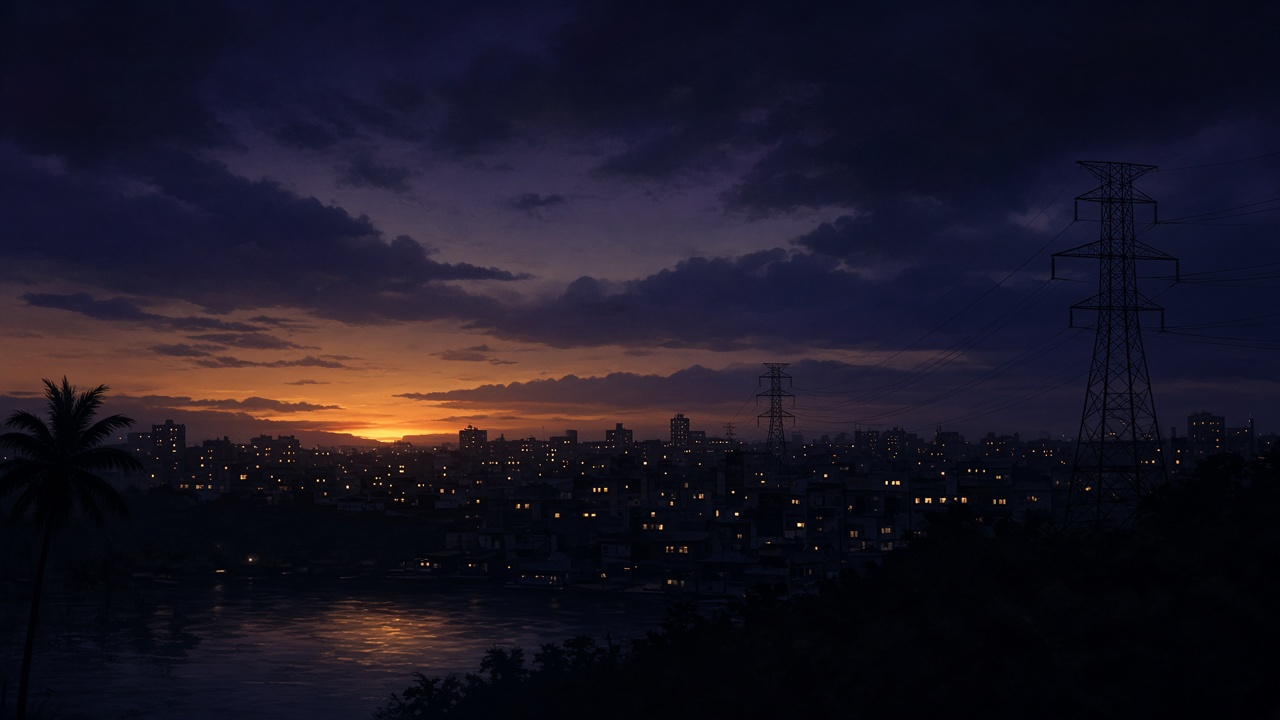
Cuba’s national electric system collapsed on Friday, 18 September 2026, plunging the island of roughly nine million people into another total blackout — the eighth full disconnection of the SEN this year, according to the state Electric Union (UNE).
Authorities said the cascade began before 2:00 pm local time when two 220 kV transmission lines out of Matanzas — Matanzas–Cienfuegos and Matanzas–Santa Clara — tripped in quick succession. UNE said unstable weather around the corridor contributed. Within minutes the grid split and then went dark nationwide.
Already running on empty
The system was brittle before the lines failed. Friday’s outage report showed only about 1,113 MW of available generation against projected demand of 3,210 MW — a shortfall that could have left more than 2,000 MW unmet even without a total collapse. Havana already had hundreds of megawatts offline and more than 100 circuits interrupted; Villa Clara reported 142 circuits out and a 204 MW deficit.
France 24 and Reuters place the failure inside a longer crisis: ageing plants, chronic fuel shortages, and a US oil pressure campaign that began in January and has tightened supplies to the Caribbean’s largest island. Rolling blackouts of 30 hours or more have become routine for many provinces. United Nations human rights experts have condemned the oil blockade as unlawful and warned that shortages risk turning Cuba into a “silent Gaza.”
Restoration by “micro-islands”
Recovery is proceeding through isolated generation pockets rather than a single national restart. UNE and provincial companies said they are prioritising hospitals, water pumping and telecommunications.
In Havana, the picture late Friday remained grim: only 11 of 26 substations and 21 of 286 distribution circuits were working, covering about 63,581 of 862,732 customers — roughly 7.4% of the capital. Of 45 hospitals, only 17 had power; one of 18 main pumping systems was online.
Elsewhere, Matanzas restored limited circuits from a Guanábana battery island that included Faustino Pérez Provincial Hospital. Las Tunas energised a health complex after 7:17 pm. Holguín kept military, paediatric and clinical hospitals, ETECSA and pumping on separate micro-grids. UNE also said Unit 2 of the Ernesto Guevara thermoelectric plant in Santa Cruz del Norte, Mayabeque, had come online to help the rebuild.
No firm timeline for full restoration was given. After earlier 2026 collapses, Havana was still at single-digit or low-teens service the following day.
A pattern, not a one-off
UNE’s tally for 2026 is stark: two total disconnects in March, three in July, two in August, and Friday’s eighth. The same Matanzas corridor had already helped trigger a major western-province failure on 2 August; a frequency swing during recovery caused another drop that took nearly 18 hours to clear. Energy minister Vicente de la O Levy has previously insisted those were not simple operator errors but the product of a stressed grid and fuel scarcity.
For residents, the distinction is academic. Frank Lorenzo, a 23-year-old in Havana quoted by France 24, said he had already gone 24 hours without power before Friday’s collapse briefly restored light for an hour — then the grid failed again.
Cuba’s eighth blackout of 2026 is less a surprise than a measure of how thin the margin has become. Until generation, fuel and high-voltage corridors regain headroom, every local fault risks becoming a national night.