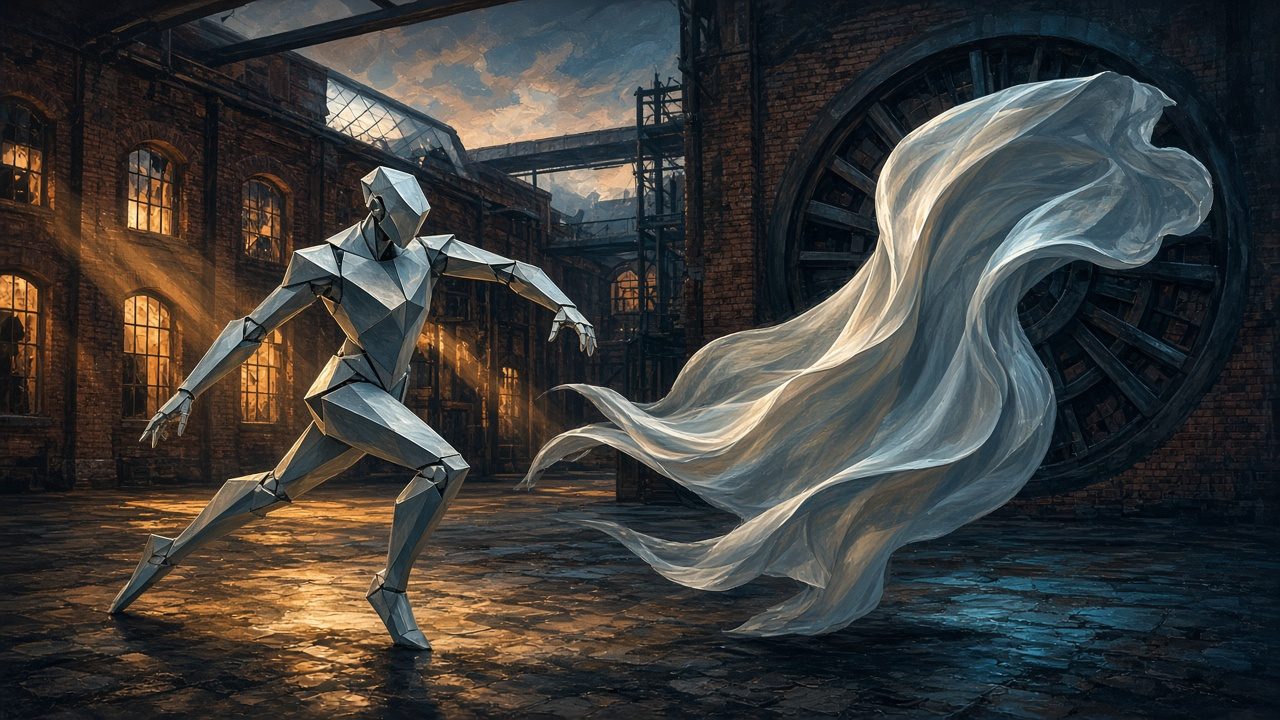
BEIJING — At dusk in the 798 Art District, a dozen mass-produced Tiangong humanoid robots shared Locomotive Square with dancers from Tao Dance Theater 2. The opening piece, billed as *Playable Technology: Infinite Walk*, launched the second Beijing Art & Technology Week — a 21-day programme running 17 September to 7 October 2026 under the theme “Playable Technology,” with more than 100 public-art, performance, forum and exhibition events hosted by Beijing 798 Culture & Technology Co Ltd.
The gesture is deliberate: robots are framed not as props but as co-performers. Guo Huaping, president of Beijing 798 Culture & Technology, told China Daily the festival aims to “marry art and technology in real settings,” advancing premieres, industrial applications and international cooperation while energising consumption across the district and the wider city. Writer and polymath Feng Tang serves as brand ambassador.
How Infinite Walk was built
Organisers describe two weeks of round-the-clock tests before opening night. Tiangong robots from the Beijing Innovation Center of Humanoid Robotics (X-Humanoid) first learned motion-capture data from human dancers; sequences were pared back after hardware limits appeared, and dancers then relearned movements to match what remained. Ding Gang, algorithm lead in X-Humanoid’s motion-control department, told reporters the performing units are general-purpose mass-produced models — a stress test for navigation, locomotion and full-body coordination under continuous high-torque athletic shifts.
Asked when robots could interact more directly with human partners, Ding said algorithmic optimisation could make that possible within a month or two. Tao Ye, founder of Tao Dance Theater, stressed the collaboration was never about substitution. “Robots will never replace people dancing. They treat humans as a benchmark to chase, while humans keep surpassing themselves,” he told China Daily, adding that contemporary art’s job is to turn uncertainty into reality.
Chinese coverage of the same opening frames the method as a first “human–machine equal creation” pipeline: human choreography, capture, machine learning and joint performance. The Infinite Walk project itself has, since 2021, accumulated nearly a thousand walking actions across factories, museums, theatres and shorelines; putting robots inside that score extends the question of how far “walking” can go.
Premieres beyond the square
Chen Baoyang’s public project *Artificial Humans: An Unfinished Dance* is billed as a story-driven tech-art experience drawing on the ancient Yanshi legend of a mechanical figure that sings and dances for King Mu — then makes a gesture it was never designed to make. Visitors move through six works invited to reconstruct the figure’s body and finish a dance interrupted for more than three millennia.
London-based digital artist Maxim Zhestkov presents the generative *Playscapes*, steered by joystick through shifting ecosystems of light and particles. Stage debuts include Cosmic Heart Theatre’s *Weave* and Easternization Movement Theater’s *Night Patrol*. District venues such as 798 CUBE, 798 Hyperdimensional Vision, UCCA Center for Contemporary Art and MACA Art Center add further art-and-technology programmes.
Forums, Ars Electronica and a new residency
An Art, Technology and Humanity Roundtable is scheduled for 24 September alongside the 798 Art & Technology Innovation Forum, where organisers say they will release a global co-creation plan for integrating art and technology in new scenarios. Ahead of the week, 798 partnered with Austria’s Ars Electronica Festival on cross-disciplinary work with Chen Baoyang and Tao Dance Theater. At the opening, 798 and Bounded Space announced the 798 Multidisciplinary Residency Platform; its first edition, themed Pre/Sense, invites global creators for interdisciplinary residencies.
The week is guided by Beijing municipal publicity, economy-and-information and Chaoyang district authorities together with Beijing Electronics Holding. For the international art-tech circuit, the news is less a single spectacle than a signal: a major Chinese art district is treating embodied AI as a public, ticketed cultural medium — and insisting, at least in its opening rhetoric, that humans remain the authors of the score.
This article draws on China Daily’s 18 September 2026 report, China Culture’s English digest of the same coverage, and Phoenix News’ opening-day account of Infinite Walk. Quotes follow those outlets.